

Originally published March 2014. Updated February 2026 to reflect current Olympic momentum and the 2026 Winter Games in Cortina.
As the 2026 Winter Olympics open in Milan and Cortina d’Ampezzo, conversations around the future of winter sport are once again in focus as the world turns their attention to Italy. While snowshoeing is not part of the current Olympic program, the moment has renewed discussion about the sport’s place on the world’s biggest athletic stage.
Snowshoeing itself dates back thousands of years as a means of winter travel, while organized competitive snowshoeing racing has existed for nearly 200 years, with documented events, championships, and international participation. Its absence from the Olympic program is not due to a lack of history or global reach. As longtime organizer, and former United States Snowshoe Association president, Mark Elmore has noted, “With a long and colorful history, we deserve to be included in the Olympic Program too.” Read on to find out why.
Read More: A Historical Perspective of Snowshoeing
Criteria for Olympic Sports
One of the main criteria for consideration as an Olympic sport is history and longevity, according to the International Olympic Committee, or IOC for short. Other requirements for being considered an Olympic event include that a sport is widely practiced. Snowshoeing clearly fills these requirements, and then some.
The sport’s continued growth further strengthens the case for snowshoeing as an Olympic discipline. Snowsports Industries of America, a nonprofit trade association for the winter outdoor industry, conducted more than 18,000 interviews to assess participation trends. Based on that research, SIA projected 3.4 million snowshoers during the 2019–2020 winter season. By comparison, the same report cited 4.8 million cross-country skiers and 25.1 million participants across all winter sports.
Beyond participation numbers, snowshoeing already has an established international footprint. World Snowshoe Federation currently includes snowshoe organizations from ten countries across five continents, underscoring the sport’s global reach and organizational foundation.
Another vital statistic is the age group of snowshoers which includes 20% under 17. Also, 25-34-year-olds are the largest percentage of participants at approximately 30%. Ages 18-24 and 35-44 each consist of about 13% of participation. Finally, 8.5% are 45-54, with the remaining 15% being over age 55. Regarding gender, about 66% of participants are male and 44% female.
Read More: The Dream Team: Increasing Diversity in Snowshoeing and Snow Sports
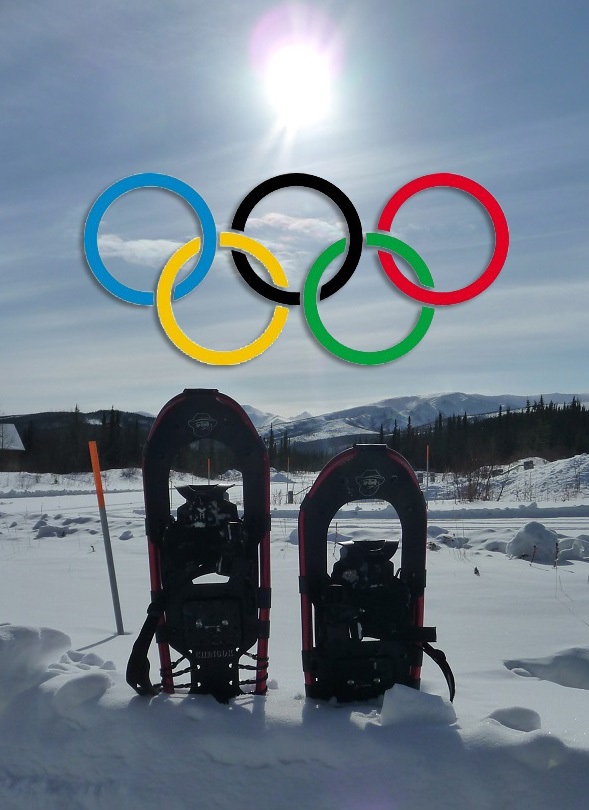
Do you think snowshoeing should be included in the Olympics? Photo: Rick Stedman
New Events
Let’s look at the IOC’s inclusion of special events over the years like slopestyle and big air. These might make you scratch your head wondering how Olympic officials rationalized their decisions. So here are a few facts: Before a new sport can be added to the lineup, an existing sport must be dropped.
However, the number of events has continued to grow at each Olympics. The 2022 Winter Olympics in Beijing had over 100 events, the largest in history. Many new events were not even invented until roughly a decade ago. Though all have been phenomenally successful events in the Winter X Games, the annual extreme sporting event each January televised by ESPN. These are somewhat entertaining but have absolutely no history or longevity as the IOC claims they must to be considered.
So, how did the IOC circumvent its own rules? They include new events under the umbrella of currently successful disciplines like alpine and cross-country skiing. Both of these sports have long histories and meet all the IOC parameters. But the reality is that there is no way any of these imported X Games sporting events come close to achieving the widely practiced requirements.
Read More: Two Weeks in the Life of an Olympic Enthusiast
Demographics and Advertising
Another critical factor is the demographics and advertising potential. The IOC has desperately been courting the new younger generations. The X Games are the perfect example of reaching those audiences. Thus, to meet their marketing and financial plans, the IOC hi-jacked a handful of sports from the X Games and deemed them official Olympic events.
To understand how important the money factor is to the IOC, look at softball and golf in the Summer Games. Softball had basically very little advertising potential. Given that glaring fact, the IOC removed it as an official sport after the 2008 Games. After that, though, the IOC added it as a one-off appearance in the postponed 2020 games. On the other hand, golf has been missing in action as an Olympic sport since 1904. Given its over-the-top worldwide appeal and lucrative advertising reach, adding golf to the 2016 Summer Games in Rio de Janeiro was a no-brainer. Ever since Peter Ueberroth showed the IOC how to profit during the 1984 Los Angeles Summer Olympics, the IOC has been on that same quest.
To Be Or Not To Be
When you take all the IOC rules, regulations, incentives, and motivations, it’s challenging to move the needle when adding a sport like snowshoeing to the Olympic lineup. Though it has the history, longevity, youthful appeal, and growing numbers, the advertising base – or lack thereof – is the one determining factor that has kept this sport from racing to the finish line in the Winter Olympics. What’s really ironic is that snowshoe racing has been a Special Olympics event since 1997 but has yet to gain the nod from the IOC.
Longtime supporters of adding snowshoe racing to the Winter Olympics feel like they are pushing a snowball up a hill. But as many people claim, this race is far from over.
Do you think snowshoeing should be an Olympic sport? Why or why not? Please share your thoughts with us in the comments below.
This article was first published on March 18, 2014, and was most recently updated on February 8, 2026 and March 8, 2022, with new data.
Read Next: Snowshoeing in the New York Empire State Winter Games




Yes snow shoe racing should absolutely be added as a Olympic sport
I concur with the author and post-comment’s sentiments, and I agree with all the supporting argument about wanting snowshoe events/racing included in the Winter Olympics. However, the stoppage seems to be in the number of countries where snowshoe racing takes place. As a past snowshoe columnist for a Midwest magazine, Silent Sports, I wrote in December 2006, “Why the Winer Olympics Excludes Snowshoe Racing.” At that time, the IOC required a minimum of 40 approved countries participating in a sport and having National Governing Bodies (NGB) recognition. In 2006, 15 countries participated in snowshoe racing, and only 3 of those countries had NGB. I do not know the current numbers of countries participating, but I am guessing we are not near the numbers required. From what I found in Britannica, the minimum number required today; “A sport must be widely practiced by men in at least 75 countries across four continents and by women in at least 40 countries across three continents” (not sure why the gender difference). Sadly, the reality is that snowshoe racing may not have garnered enough worldwide attention at this time.
A huge YES! Snowshoeing is a great competitive sport and has as much historical significance as many other Oly athletics! Matt makes a good point of having Nordic Sprint snowshoe comps! Sadly, this is not as popular as the 5K, 10K and longer races. It would be even more competitive to create a pentathlon Nordic combination which can be a one-day or two-day event.
Thank you for sharing your thoughts, Stephen! It’s challenging to navigate all the logistics of adding snowshoeing as a sport. However, with the continued growth in popularity, we hope we’re getting closer to snowshoeing being part of the Olympics! -Susan, Snowshoe Mag Editor
Snowshoeing definitely belongs in the Olympics, besides snowshoe running a “snowshoe cross” off trail event would be great, thrills and spills make good TV.
Agreed, WarrenB! It would be great to see snowshoe racing as an event, especially considering track and field has been a centerpiece of the Summer Olympics for over a hundred years. We can only hope we’ll see snowshoe racers out there at some point. Thanks for sharing your thoughts! – Susan, Snowshoe Mag Editor
My father and I met with the Olympic Committee in either 1989 or 1990 to try and get snowshoeing in as a show sport in Albertville, France. The Snowshoe Club that Roland D. Tanguay (my father) was the President of, I believe, was the first in the USA formed in 1924. He was the first person to present this to the Old.
Wow!! That is so neat that your father was the President of the first Snowshoe Club and you both met with the Olympic Committee! Adding snowshoeing as an Olympic sport is one of the publication’s goals as well. Thank you for advocating for the sport and for sharing your story. 🙂
Hey Snowshoe Enthusiasts!
Let’s promote Nordic Sprint snowshoe comps; 100m, 200m & 400m competed on a 300m snow/ice track. Unfortunately, this event has been long ignored in favor of the 5K & 10K races. Here, in the USA there’s only one comp per season and it’s in upper state NY. Let’s work together to promote all aspects of snowshoeing and revitalize the sport!
Hi Rick……we have had many a discussion here in Collingwood, Ontario regarding the inclusion of snowshoeing as an Olympic sport…..we have hosted The Switchback Challenge, a 5K-10K event at Craigleith Ski Club for the past nine years, and look forward to our tenth anniversary in 2015…….the process for creating a formal provincial snowshoe association is quite involved, not to mention what it would take to form a national body…..would appreciate your thoughts on this, but think your article is right on the money……all the best…..Hugh
Rick you’re literally & figuratively “right on the money” when you reason lack of potential advertising dollars inhibiting Olympic snowshoeing. While the snowboarding events of this past Olympics were great to watch, it was patently clear they were added to attract the targeted, bountifully-economic based younger audiences. My sense is that same audience would find snowshoeing events boring and tune out. That’s something advertisers fear. If the ever-growing number of snowshoe enthusiasts is persistently vocal, perhaps those same advertisers will realize “there’s Olympic gold in them that snowshoe dollars”.
Excellent article we will find you the 2 other missing coutries. This sport is excellent for cardio. Extreme snowshoeing up in the Laurentians in Morin Heights Québec, Canada is absolutely a killer. You can have a walking competition, a short run, a long run an obstacle race, up hill run in the forest…name it! Its an ideal sport. Not too expensive for the entire family. I rediscover this sport this winter because of my sister who giv eme a pair of snowshoes and I’m telling you, Im back in shape! You don’t go downhill skiing when its -30 but you can go snowshoeing and crosscountry skiing. No excuse not to go out and enjoy the winter season.
Hey Rick!
You’re absolutely right on! Snowshoeing is a great competitive sport and has historical significance. I love snowshoeing and I spread the word as much as possible. It’s great for recreational purposes and a magnificent athletic endeavor. It allows folks to see part of nature otherwise would never have been explored. Keep up the great work in spreading the word and educating the need for the sport to be in the Olympics!
Thank You,
Matt